
Choosing globo colors is not just a design task.
For wholesalers, distributors, and event planners, it directly affects sourcing efficiency, batch consistency, and installation performance.
A professional balloon color plan balances visual impact with production stability.
This guide explains how to evaluate finishes, build scalable color combinations, and reduce reorder risk.
What Makes a Balloon Color Plan Work in Large Events
A reliable color strategy depends on three factors:
- Globo finish and material
- Color relationship and contrast
- Production and batch consistency
Ignoring any one of these increases cost variance and visual mismatch in large installations.
Lo esencial
Start with material and supply consistency before focusing on visual inspiration.
Choose the Right Balloon Finish Before Finalizing Colors
Globo color appearance changes depending on surface finish.
The same pigment looks different in matte, pearl, or chrome.
How Different Balloon Finishes Affect Color Appearance
| Finish Type | Surface Effect | Best Use Case | Relative Cost |
|---|---|---|---|
| Matte Latex | Non-reflective, stable tone | Large arches, garlands, corporate installs | Low |
| Pearl Latex | Soft sheen | Weddings, indoor multi-day events | Medio |
| Metallic Latex | Reflective surface | Evening events, holidays | Medio |
| Chrome Latex | Mirror-like coating | High-impact focal displays | Alta |
| Transparent Latex | Light-passing | Layered designs, confetti fill | Medio |
How Finish Selection Impacts Wholesale Cost
- Matte latex globos offer the highest cost efficiency for bulk programs.
- Pearl and metallic finishes increase coating cost.
- Chrome balloons require additional surface treatment.
A balanced structure for large projects:
- 60 percent matte base
- 30 percent secondary tone
- 10 percent accent or chrome
Lo esencial
Use specialty finishes strategically rather than as volume drivers.

Two-Color Balloon Combinations That Scale Easily
Two-color systems are the most stable model for wholesale programs.
Classic Combinations That Maintain Demand
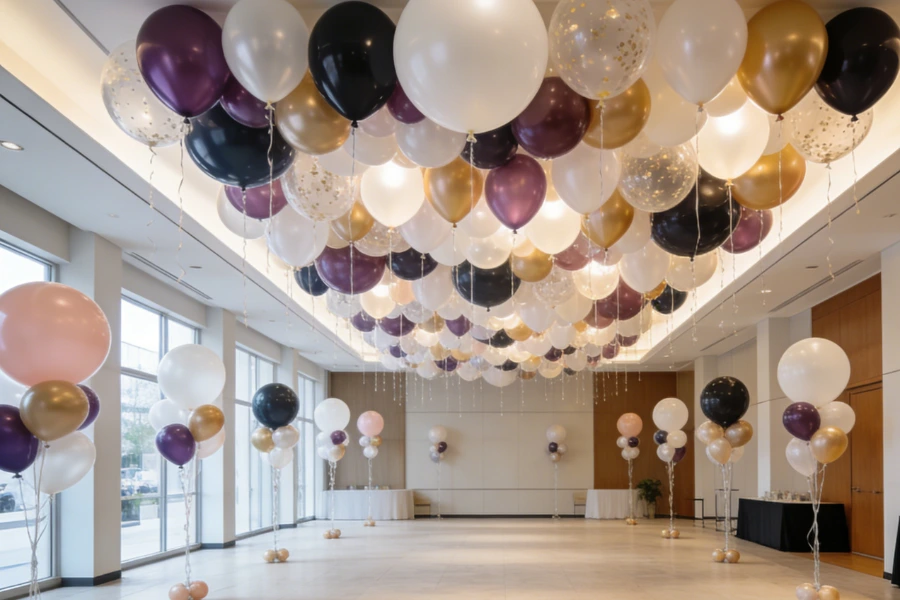
- Black and gold
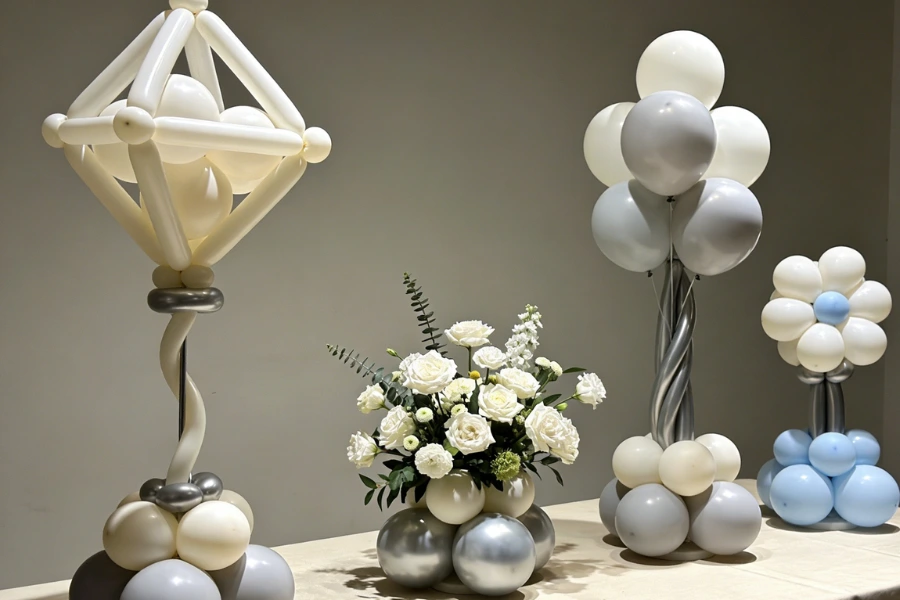
- White and silver
- Navy and white
- Blush and white
- Red and gold
These combinations reduce SKU complexity and simplify replenishment cycles.
Modern Neutral Trends for Lifestyle Brands
- Sage and terracotta
- Dusty blue and champagne
- Mauve and grey
- Olive and blush
These palettes align well with wedding and seasonal programs.
Lo esencial
Two-color systems reduce overstock risk and simplify forecasting.
When to Use Three-Color Balloon Schemes
Three-color combinations create hierarchy and visual depth.
Apply the 60-30-10 structure:
- 60 percent dominant base
- 30 percent secondary
- 10 percent accent
High-Contrast Trios for Corporate Use
- Black, red, gold
- Emerald, gold, black
- Royal blue, silver, white
Soft Transitional Trios for Events
- Blush, mint, ivory
- Peach, sage, cream
- Lavender, baby blue, pearl white
Lo esencial
Three colors increase visual sophistication without multiplying inventory complexity.
How to Plan Color Flow for Balloon Arches and Garlands
Large structures require controlled transitions.
Balloon Arch Color Planning
- Monochrome gradients, navy to sky blue
- Light interior with bold exterior double arch
- Matte base with metallic highlights
For outdoor arches, choose saturated pigments to reduce visible fade.
Balloon Garland Color Planning

- Analogous flow, teal to blue to white
- Earth-tone blend, terracotta to beige to sage
- Transparent latex used as spacing element
Lo esencial
Confirm color sequencing before confirming production quantities.
Why Batch Consistency Matters in Balloon Color Programs
Color mismatch becomes noticeable in installations exceeding several hundred units.
Key control points:
- Pigment formulation stability
- Batch coding control
- UV resistance performance
- Temperature-sensitive storage impact
For repeat wholesale programs, confirm:
- Pre-production swatch approval
- Defined color tolerance range
- Consistent pigment sourcing
Globo color matching is both a design decision and a production discipline.
Recommended Color Strategies by Event Type
Corporate Franchise Rollout
Recommended approach
Monochrome base with metallic accent
Razón
Easy replication across regions
E-commerce Seasonal Launch
Recommended approach
Limited three-color system
Razón
Reduces inventory overlap
Multi-Day Indoor Display
Recommended approach
Matte combined with pearl
Razón
Reduced glare under LED lighting
Outdoor Festival
Recommended approach
Saturated matte latex
Razón
Improved visual stability in sunlight
How Lighting Changes Balloon Color Appearance

Lighting conditions alter perception.
Natural daylight:
- Pastels perform well in morning
- Bright hues show strongest at midday
- Metallic finishes reflect strongly in afternoon
Artificial lighting:
- Pearl under LED produces softer glow
- Chrome responds well to spotlight
- Dark tones anchor dim venues
Always test color swatches in final lighting conditions before approving mass production.
How to Standardize Balloon Colors for Long-Term Programs
Start with core color discipline.
Primary colors
Red, blue, yellow
Secondary colors
Green, purple, orange
Use structured relationships:
- Complementary for contrast
- Analogous for smooth transitions
- Triadic for balanced variety
For wholesale programs, standardize 8 to 12 core shades to simplify procurement and storage.
Lo esencial
Standardization improves reorder accuracy and brand consistency.
Color Planning and Long-Term Supply Stability
Color decisions influence:
- Inventory turnover rate
- MOQ management
- Production scheduling
- Warehouse rotation
For distributors managing multiple themes, consolidating shared base colors improves efficiency.
When evaluating balloon suppliers, review:
- Pigment consistency history
- Yield rate performance
- QC documentation
- Custom color development capability
Balloon Color Matching Is a Supply and Branding Decision
Balloon color combinations affect more than visual design.
They influence sourcing stability, cost structure, and brand presentation.
Reliable programs:
- Limit excessive SKU variation
- Balance matte and specialty finishes
- Control batch consistency
- Match color to real installation conditions
If you’re evaluating suppliers for long-term balloon color programs, Nicro supports both private label and OEM development models.
With over 10 years of manufacturing experience and a 6000㎡ production facility, Nicro manages pigment consistency, batch control, and customized palette development for wholesalers and event brands.
Free sample verification is available before mass production so buyers can confirm shade accuracy under real lighting conditions.
The goal is long-term supply reliability and scalable growth.
FAQ
Q1. How do I choose the best balloon color combinations for large events?
Start with a dominant base color, add a secondary tone for contrast, and use a limited accent color. A 60-30-10 structure improves visual balance and simplifies bulk sourcing.
Q2. What balloon finishes work best for professional installations?
Matte latex provides stable tone and cost efficiency for volume. Pearl and metallic finishes add depth under lighting. Chrome should be used as an accent due to higher unit cost.
Q3. How can I prevent color mismatch in large balloon orders?
Approve physical color swatches before production, confirm batch coding controls, and standardize core shades. Consistent pigment sourcing reduces visible variation across installations.
Q4. Which balloon colors perform best under LED lighting?
Pearl and metallic finishes reflect LED lighting effectively. Dark matte colors anchor dim venues, while chrome responds strongly to spotlight environments.
Q5. What are the safest balloon color systems for wholesale programs?
Two-color systems are the most stable and scalable. Limited three-color palettes work well for seasonal collections while keeping inventory manageable.
Q6. How many balloon colors should a brand standardize?
For long-term programs, 8 to 12 core shades are manageable. This supports brand consistency, reduces overstock, and improves reorder accuracy.

- Balloon Color Matching Guide for Events, Brands, and Wholesale Buyers - febrero 16, 2026
- Balloon Centerpiece Ideas That Work for Events and Wholesale Programs - febrero 15, 2026
- Tutorial para colgar globos - 14 de febrero de 2026


 English
  Spanish
  German
  French
  Dutch
Dutch  Italian
  Japanese
  Korean