
A Decision Framework for Scalable Helium Displays
Helium ballonnen are simple in concept but operationally sensitive.
If the counterweight is undersized, unstable, or inconsistent, the entire display loses control.
A DIY balloon counterweight can work well in certain scenarios. However, for brand owners, wholesalers, and event planners, the real question is not how to make one — it is when DIY makes operational sense.
This guide focuses on decision-making, performance, and scalability.
What a Balloon Counterweight Actually Needs to Do
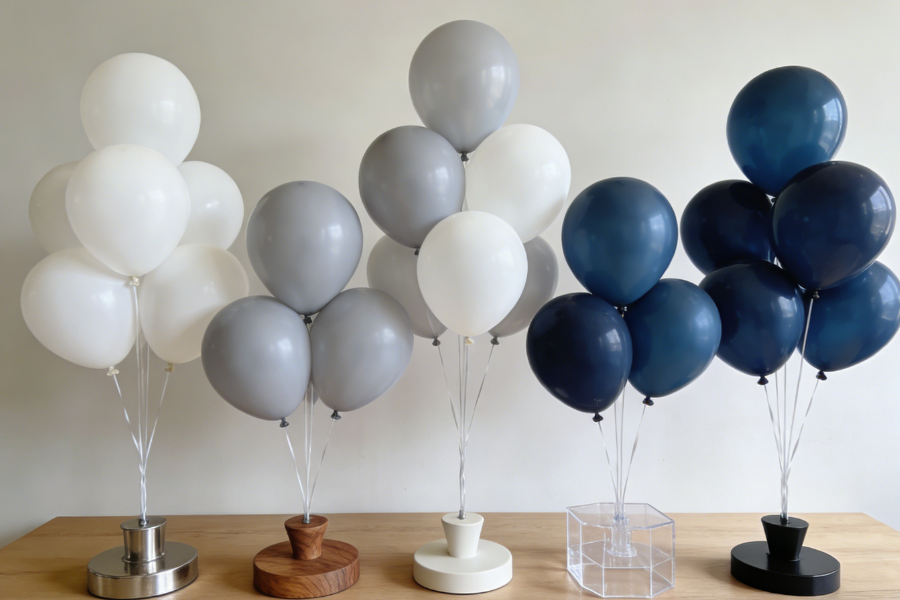
A counterweight must resist three forces:
- Upward helium lift
- Lateral pull from ribbon tension
- Environmental movement such as drafts or handling
For commercial installations, stability is not just about weight. Base diameter, tie-off method, and surface friction all influence performance.
The bottom line — weight alone does not guarantee stability.
How Much Weight Is Required
Below is a practical baseline per single helium-filled ballon. Always test bundles before deployment.
| Balloon Type | Typical Counterweight Range |
|---|---|
| 9-inch latex | ~1 oz, 28 g |
| 11-inch latex | ~1.5 to 2 oz, 42 to 56 g |
| 16-inch latex | ~3 to 4 oz, 85 to 113 g |
| 18-inch foil | ~5 to 6 oz, 142 to 170 g |
| 36-inch latex | ~8 to 10 oz, 227 to 283 g |
For bouquets, lift adds up quickly. A five-balloon 11-inch bundle may require 8 to 10 oz total, depending on ribbon length and airflow.
In retail or hotel installations, adding a 20 percent safety margin reduces tipping risk.
DIY Counterweight Materials Compared
DIY counterweights usually consist of a container plus filler. The choice affects cost, mess risk, consistency, and reuse value.
| Filler Material | Cost Level | Density | Reuse Value | Risk Profile | Best Scenario |
|---|---|---|---|---|---|
| Sand | Low | High | Medium | Spill risk | High-volume short events |
| Pebbles | Low to Medium | Medium | High | Low mess | Reusable centerpiece kits |
| Rice or Beans | Low | Medium | Low | Moisture risk | One-day indoor events |
| Metal Washers or Coins | Medium | High | High | Low | Corporate repeat installs |
| Water | Low | Adjustable | Low | Leakage risk | Fast temporary setups |
Practical Observation
Sand offers compact density but introduces dust and spill issues during transport.
Metal fillers provide excellent consistency but increase material cost.
Water appears convenient but complicates shipping and storage.
Container Selection Matters More Than Most People Expect
A narrow bottle filled with heavy material still tips easily.
A wider base distributes force and improves lateral resistance.
When choosing containers, evaluate:
- Base diameter
- Tie-off point stability
- Surface texture against flooring
- Stackability for storage
For commercial use, uniform container shape simplifies packaging and reduces setup errors.
When DIY Makes Operational Sense

DOE-HET-ZELF ballon counterweights are practical when:
- Event scale is small
- Labor cost is minimal or internal
- Design flexibility is more important than uniformity
- Transport distance is short
They are often suitable for:
- Boutique private events
- Low-volume party rental companies
- Internal corporate celebrations
In these cases, DIY can control upfront material cost.
When DIY Becomes Operationally Risky
DIY loses efficiency when:
- Volume exceeds 100 units per event
- Staff must assemble onsite under time pressure
- Consistency across locations is required
- Branding must remain uniform
At scale, variability becomes the main issue.
Common field problems include:
- Inconsistent fill weight
- Ribbon slippage
- Container tipping due to narrow bases
- Spillage during transport
These are not material problems — they are process problems.
DIY vs Manufactured Counterweights
For sourcing decisions, this comparison clarifies trade-offs.
| Factor | DIY Counterweight | Manufactured Counterweight |
|---|---|---|
| Upfront Cost | Lower material cost | Higher unit price |
| Labor Requirement | High | Low |
| Weight Consistency | Variable | Standardized |
| Brand Appearance | Custom but inconsistent | Uniform |
| Scalability | Beperkt | High |
| Packaging Efficiency | Low | Optimized |
The bottom line — DIY reduces purchase cost but increases operational complexity.
Stability Is Not Only About Weight
Stability depends on force distribution.
Shorter ribbon length reduces leverage.
Wider bases increase resistance to tipping.
Secured tie points prevent gradual slippage.
For outdoor setups, increase total weight and reduce ribbon height. Wind amplifies lateral load far more than helium lift alone.
Risk Management for Professional Use
If you choose DIY, implement controls:
- Pre-weigh filler using digital scales
- Standardize container models
- Use double-knot tie-off with slip prevention
- Perform pull testing before deployment
- Add 10 to 20 percent safety margin for draft-prone venues
Operational consistency reduces last-minute corrections onsite.
The Strategic View for Brands and Wholesalers
If ballon counterweights are part of your product assortment, consider:
- Are customers using them repeatedly
- Do they need private label packaging
- Is consistent weight performance part of your brand promise
- Does your team spend excessive labor assembling them
At early business stages, DIY may bridge the gap.
As order volume increases, standardized production improves predictability.
The Bottom Line
DIY balloon counterweights are functional and cost-effective in controlled, small-scale settings.
However, as event size, distribution scale, or branding requirements increase, consistency becomes more valuable than initial material savings.
If you’re evaluating ballon accessory sourcing for long-term production, Nicro supports OEM and ODM manufacturing paths for party supplies, including scalable accessory components designed for uniform performance and wholesale distribution.
The goal is not simply to hold balloons down — it is to hold operational standards steady.

- DIY Balloon Counterweight Guide - februari 18, 2026
- Arabian Nights Theme Party - februari 17, 2026
- Balloon Color Matching Guide for Events, Brands, and Wholesale Buyers - februari 16, 2026


 English
  Spanish
  German
  French
  Dutch
Dutch  Italian
  Japanese
  Korean